HISTORY OF THE KENTUCKY RAILWAY MUSEUM
The Kentucky Railway Museum owes its beginning to a small number of rail enthusiasts who formed a local chapter of the National Railway Historical Society in 1948. In the early 1950s, the Chapter asked the Louisville and Nashville Railroad for the donation of a steam locomotive to form the nucleus of a railway museum.
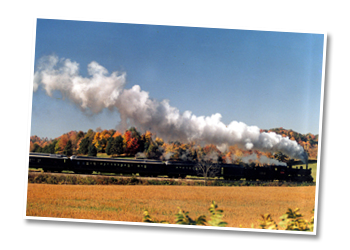
The museum was officially chartered in 1954, and with the donation of steam locomotive #152, leased six acres of land on River Road, opening to the public on Memorial Day, 1958. The museum grew with the addition of other donated rail equipment and artifacts, with over 100,000 visitors coming through the gates by the early 1960s. Over 200,000 people came to the River Road site in the first 10 years of operation!
Because the original site was subject to flooding, and the museum required additional space for exhibits, the museum signed a lease for 40 acres of land near Ormsby Village on LaGrange Road, which would expire in 1993.
Meanwhile, a dedicated group of museum volunteers, with grant funds from the Brown Foundation and the National Park Service, began an operating restoration of L&N 152. The thirteen-year labor of love came to fruition in September 1985, when the engine was moved under its own power after thirty years' retirement. All of this work was performed in an outdoor shop, totally by volunteers, and stands as one of the best examples of a preserved operating steam locomotive in the country today.
The museum acquired a fleet of passenger cars to operate behind #152, as well as operating diesel-electric locomotives, to operate off-site excursions on the L&N Railroad.
The euphoria of a permanent home did not last, however, as Jefferson County informed the museum that the Ormsby Village lease would not be renewed in 1993. Once again, a search was on, this time for a site the museum could purchase and call home for good.
No such site existed in Jefferson County, but CSX Transportation was considering abandonment of the Lebanon Branch of the old L&N from Boston east, eventually to Mt. Vernon, Ky. With strong support from the Bingham Foundation and a state economic development grant, the museum purchased seventeen miles, from just east of Boston to New Hope in LaRue and Nelson Counties. This cost some $30,000 per mile.
Two brothers in New Haven, Kentucky, just south of Bardstown, donated six acres of land and a building for museum headquarters. The move to permanent facilities opened July 4, 1990.
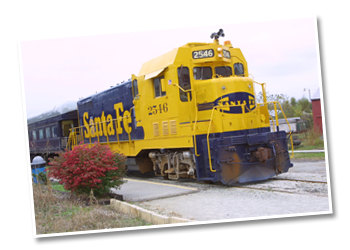
Since then, the museum has grown and prospered. More than 40,000 visitors, many of them students on field trips, visit the museum each year. A new 5,000 square foot museum, a replica of the original brick L&N New Haven depot, opened in the summer of 1995. Tracks are under construction for display of restored rolling stock, and the museum has over seventy pieces of rail equipment.
Most Class I railroads have discouraged or discontinued mainline excursion trains, so the decision to own its own railroad was a wise one for the museum. Today, the locomotive that started it all, L&N 152, still brings goose bumps when the whistle sounds through the scenic Rolling Fork River Valley, just as it did in those long ago days when America moved by rail.
Kentucky Railway Museum, a private non-profit organization, continues to tell the story of the people who built the railroad through interpretation and operation of the historic equipment.
HISTORY OF 40-ET-8 BOX CAR
The 40-et-8 boxcar was a standard European Box Car made in France and used during WW1 and WW2. During both wars, the boxcar was used to transport 40 soldiers or 8 mules and horses around Europe. This car was built in Lyons, France in 1905 or 1908 (?) for use on the Paris - Lyon - Mediterranean Railway (PLM.)
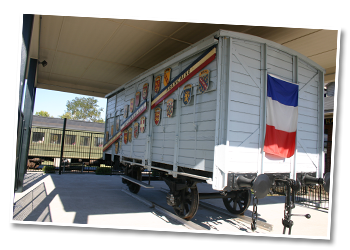
After WW2 the French people donated one car to each state plus one to be shared by the District of Columbia and the Territory of Hawaii. The boxcars were filled with items of appreciation that may have included crafts, food, art, and gift items. In 1949 the cars were presented to each of the states.
This 40-et-8 car was given to Kentucky Railway Museum in 1958. Between 1997 and 2001 the Nelson County Technical Vocational School located in Bardstown, Kentucky restored the car to its original state under the supervision of Mr. Chris VerDow.
The Plaques that are displayed on each side of the boxcar represent the Provinces of France. The car was returned to Kentucky Railway Museum in May 2001 where it is on display.
Funding for the restoration project was provided in part by the Kentucky Order of Colonels and the 40-et-8 Society of Elizabethtown. For more information, please see www.rypn.org.